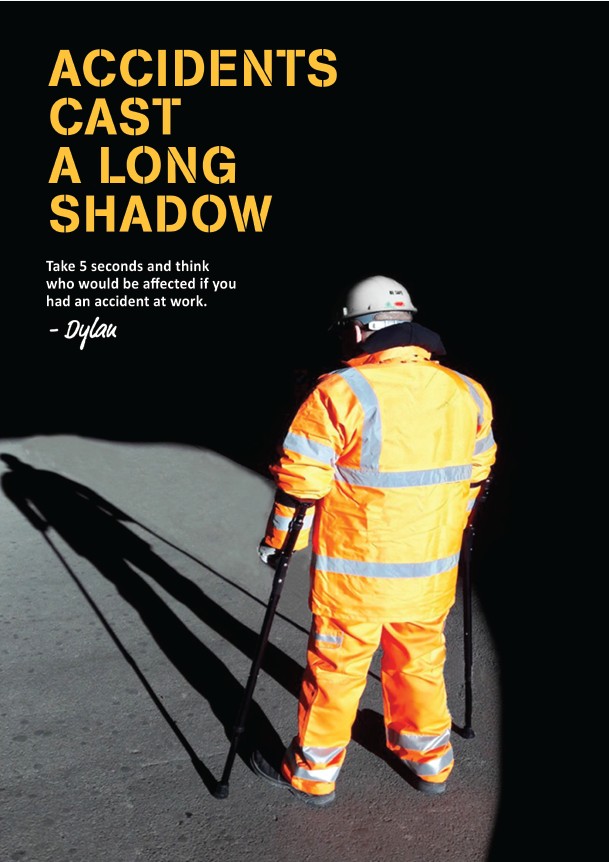
“For Just a Day’s Money, It’s Never Worth the Risk”: How Dylan Skelhorn Is Changing the Way Bell Works at Height.
Every year, thousands of tradespeople climb a ladder, step onto a roof, or lean out over a fascia board without a second thought. It’s routine. It’s quick. It’s “only five minutes.” And that, according to Dylan Skelhorn, is exactly the moment when things go wrong.
Dylan is a former Solid Fuel Heating Engineer, a survivor of a serious fall from height, and the founder of Safety Up. The health and safety speaker has spent the last 12 years travelling the length and breadth of the UK and across the globe, as far afield as Taiwan, delivering powerful working-at-height talks. Since 2019, Dylan has worked closely with Bell, and in 2024 he completed a nationwide tour, presenting to every region of the business, from branch teams to senior management.
We sat down with Dylan to talk about that journey, what he saw across our 37 branches, and why he believes the culture we’re building at Bell is genuinely different.
How it started
Dylan’s relationship with Bell goes back to July 2019, when he was first asked to present in Glasgow; a session at our Newcastle College Bell Academy followed the very next week. The topic, working at height safety and ladder safety, subjects Dylan knows better than most, having lived through the consequences of a fall himself.
The feedback was strong enough that Bell invited him back. In October 2023, Dylan delivered a two-day session at Airdrie Stadium to employees and management across the Scottish regions, the first time he met Carl Starling, who had just joined the company as Health & Safety Director. That relationship grew into something much bigger: from March to December 2024, Dylan toured the UK, presenting to every single region of Bell.
One presentation, one changed mind
Ask Dylan for the moment that sums up why he does this work, and he doesn’t point to a statistic. He points to a conversation.
After a session in the south-west of England, a Bell operative approached him and explained that he’d planned to spend his weekend up a ladder cleaning his own gutters. His wife had already told him it wasn’t worth the risk, but he wanted to save the cost of hiring a scaffolding company. After hearing Dylan’s story, he changed his mind entirely. He booked the scaffolders. As Dylan puts it, “he didn’t care how much it cost” anymore.
It’s a small, human example of exactly the shift Dylan is trying to create: from “I’ll take the risk to save time or money” to “no job is worth what I could lose.”

The feedback that tells you it landed
Dylan is quick to point out that polite applause after a talk doesn’t tell you much. The real measure is what people say, and write, afterwards. Bell employees have sent him messages that go well beyond a thank-you note.
One operative, reflecting on 35 years around ladders and the loss of family members to asbestos-related illness, wrote to Dylan afterwards:
“We all have moments when we feel invincible but as you’ve proved today, we’re not… for just a day’s money, it’s never worth the risk.”
Health & Safety colleagues at Bell described the session as one of the most powerful talks they’d experienced, with one manager in Taunton noting that the impact came not just from hearing about the fall itself, but from understanding the financial and emotional aftermath, the parts of an accident that don’t show up on an incident report.
That’s the piece Dylan pushes hardest on: an accident doesn’t end when the physical injury heals. It changes a life, and it changes the people around that person too.
Why “just a five-minute job” is the most dangerous job
We asked Dylan whether property maintenance work, smaller, repeat jobs like a roof here, a fascia there, carries different risks compared to a large, tightly controlled construction project. His answer was blunt: it’s often more dangerous, not less.
Short-duration jobs create a false sense of security. If you’re only up there for a few minutes, it’s easy to convince yourself the risk is small. But a ladder isn’t collective fall-arrest equipment, it can move, slip, or simply not be secured properly. Dylan knows this better than anyone.
Rules you’re told to follow vs. rules you understand
One of the most striking parts of our conversation with Dylan was the distinction between two types of operative. Someone who follows safety rules purely because they’ve been told to will, sooner or later, cut corners when nobody’s watching, because deep down they still believe “it won’t happen to me.” Someone who actually understands why the rules exist works safely even when no one is looking, because it’s about pride and self-respect, not compliance.
Getting a workforce from the first mindset to the second isn’t about more signage or stricter enforcement. For Dylan, it’s about making the message personal, which is exactly why his talks focus so heavily on family.
“99% of people come to work to provide for their families,” Dylan told us. The moment people understand that an accident doesn’t just hurt them, it hurts everyone who depends on them, attitudes start to shift in the room.
What Dylan sees in Bell’s safety culture
Having now presented to teams across every region of the business, Dylan has a fairly rare vantage point on how Bell compares to other companies. His view is that Bell’s safety culture stands out for one specific reason: people are genuinely allowed to speak up.
Dylan has seen the alternative first-hand, companies built on subcontracted labour, where workers move between sites with wildly different safety standards from one day to the next, and where raising a concern can get you shut down or sidelined.
At Bell, where the workforce is directly employed rather than a shifting pool of subcontractors, Dylan believes there’s a consistency, everyone works to the same standard, every day, on every site.
As Dylan says: “You can take the horse to water, but you can’t make it drink.” Ultimately, safety comes down to the individual on the tools that day. But a company can still build the conditions that make the safe choice the easy choice, by setting clear standards, and by making sure nobody is punished for stopping a job that doesn’t feel right.
The message we want every Bell employee to carry
If there’s one line Dylan hopes sticks with people five years after hearing him speak, it’s this:
There’s no job in this world worth risking your life for.
Or, as Dylan puts it to every room he stands in front of:
Think safe. Work safe. Home safe.
That’s not just a slogan, it’s the standard we hold every one of our teams to, on every roof, every ladder, and every job, in every one of our 37 branches. Dylan’s story is a powerful reminder of why that standard matters, and we’re proud to have him working alongside us to help make sure our people go home safe, every single day.
Find out more about Dylan: https://www.safetyup.co.uk/